
It’s all about Excel and CPM ..not Excel vs CPM
By Kim Pinkerton | 20 January, 2021 |
Category: Budgeting, Planning & Forecasting
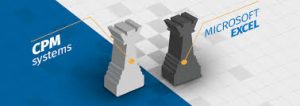
EXCEL is here to stay..
“Siloed spreadsheet-based planning, complete with system crashes, version-control and many other issues, can no longer support today’s scale or pace of business. Instead, flexible and agile planning can happen only when companies have a more connected view of data that springs from a common source and then flows across the organization.”
I’m not sure who this quote is attributable to, however it is something we can all to some extent agree with. Every business would have experience with the ‘temporary spreadsheet model’ that becomes much more than temporary, and starts to take on a level of importance and complexity well beyond that which was originally intended.
…but CPM platforms have joined the Excel party
On their own, spreadsheets are often limited by the above, and despite this many businesses are hesitant to move away from the flexibility and familiarity of Excel and their existing models and spreadsheets. This is largely because up until recently, most alternatives offered up are an either/or choice between traditional Excel planning solutions and Corporate Performance Management (CPM) platforms. It was all about replacing Excel with another product, but that no longer has to be the case.
Despite disdain for Excel across many industries, and the countless startups that have set out to kill Microsoft’s omnipresent spreadsheet software, according to Gartner, some 80% of businesses still use Excel for planning. Rather than trying to fight that, there are now a lot of products in the market seeking to complement it, offering access to their platform via an Excel add-in. The aim here is to help reduce or eliminate the spreadsheet chaos without losing the advantages and familiarity of Excel and existing models.
For example, a company may maintain multiple local spreadsheets across business planning, analysis, and forecasting. Whilst these work, there is undoubtedly and often a lot of effort involved to ensure they are updated, often manually, and data reconciles between them. The industry narrative would have corporate finance teams believe their affinity for Excel is foolish, backwards, and misplaced. That those who fail to wean themselves from Excel quickly face a bleak future indeed. This no longer need be the case
It’s not about Excel vs CPM, but Excel AND CPM
What if you could keep Excel and continue to enjoy the control, self-sufficiency, and creative license you’ve come to rely on while achieving all of the benefits of CPM software, including single version of the truth, secure multi-user workflow, intuitive analysis, and reporting? What if you could keep Excel and, in the words of a recent Harvard Business Review report, “react quickly, increase productivity, and compete effectively?”
You can … by combining Excel with a CPM solution.
Rather than throw your spreadsheets away and reinvent the wheel with a CPM, you can implement one of the CPM offerings from bi5 and transform Excel into an enterprise platform.
All of bi5’s CPM software offerings have a familiar Excel interface, so you get the benefits of Excel plus the benefits of a CPM solution.
Multi-dimensional modeling, for example, allows teams to continue to work within the familiar Excel environment while scaling your models to cloud cubes with 1,000 times the capacity, a direct link to your ERP or general ledger and other source systems, and multi-user security. In such an arrangement, the capacity, version control, and fragility issues of traditional end-user Excel are eliminated, and the models are unbreakable, remaining penny-accurate with automated data flows.
There are no switching costs to rip out your old Excel spreadsheets and replace them with an entirely new system. There’s less business interruption because you’re not losing time and productivity while your financial analysts are trained in new technology. User adoption goes smoothly because the user is already at home in the Excel environment. Plus, the cubes that turn Excel into an enterprise CPM solution can be designed and managed by the finance team without the need for IT.
Financial analysts are some of the most underutilised assets at most corporations. A modern CPM solution with an Excel interface empowers them by keeping them in control of their new system, encouraging self-sufficiency and leveraging their hard-earned Excel modeling skill and creativity. Instead of maintaining spreadsheets, analysts can use their talents to perform driver-based revenue forecasting, expense budgeting, compensation planning, capital budgeting, allocations, supply-demand forecasting and profitability forecasting.
Faster forecasts and re-forecasts lead to better, faster decisions that can increase the velocity of the business.
Many teams are looking to newer tools and technologies, and to build tighter bonds with the rest of the business so information flows with less friction. But that data has to flow both ways, and Finance needs it as much as the business does. Finance is moving out of the zone of just financial data.”
The bigger picture is giving FP&A more than just a financial point of view. So now, instead of expecting a single forecast, for example, the business expects multiple forecasts from multiple perspectives. Instead of one budget, there will be many. Now couple that with the need for speed and FP&A just can’t be expected to do it without help.
You’re going to need the technology and the tools that will get you through your decision cycle faster and support you in a different way. You have to have your data in place. You have to have your systems in place that will allow you to make the decisions faster, to re-forecast faster. You need to be closer to the business, to get that information that only the business has, because they’re the ones who are closest to the market.
The ‘progressive’ CFO thinks differently.
Technology is moving fast. There are many powerful, new solutions available and, to be progressive, CFOs need to understand the value of IT and Finance communicating and working together, with the business’ profit, reputation and growth being common goals.
So the next time you read about the imminent extinction of spreadsheets, dismiss the CPM vs. Excel groupthink and ask: “What if I could have both?”
January 2021
